
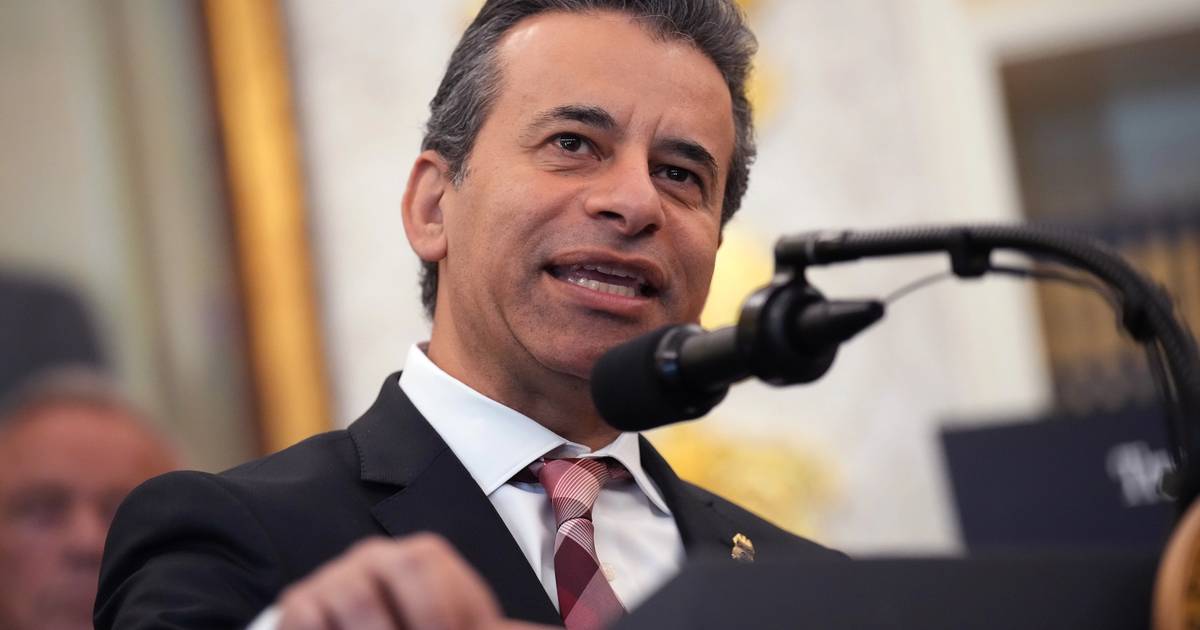
FDA Commissioner Marty Makary talks the ‘AI revolution’ at the FDA
Last week, the Washington Post reported the Centers for Medicare and Medicaid is “going all in on AI.” But it’s not the only federal health agency doing so.
FDA Commissioner Marty Makary, an embattled pick who was confirmed on March 25 last year, sat down for an interview with Healthcare Brew to talk about how AI is already in use at the agency (though there have been anonymous complaints about some of the tools) and how pivotal he believes it is for the pharmaceutical industry. He also shared about his plans for the technology, ‘including long-term goals for making drug approval more efficient using AI.
This interview has been edited for clarity and length.
I heard you mention at the JPMorgan Healthcare Conference in San Francisco in early January that the FDA has built 150 new AI systems. What are these tools exactly, and how do they work?
We asked the developer community at the FDA…to think creatively about any workstream that they can improve with technology, and specifically AI.
We got 181 submissions, and they were across all sorts of workflows at the agency. For example, document processing, automating parts of the review, triaging the submission, ensuring that the formatting is correct. That tends to be a very tedious task that’s done by humans. But now our scientific reviewers have the option to have that done with AI help…It helps them look for safety signals. Some of the tools are really quality assessment. Some help with manufacturing by targeting the high-yield areas of manufacturing. A lot of workflow optimization, compliance support, research.
What effect have the tools had so far?
The 181 submissions have not been implemented. They are being reviewed and socialized. So what we currently have are some pretty impressive AI tools that we implemented last year, and that is an AI reviewer tool and agentic AI for the reviewers with specific buttons for certain tasks.
What are your thoughts on the current state of AI in healthcare?
We have a construct at the FDA that comes from [before] the AI revolution, and it’s not working. It’s stifling innovation, so we’ve got to modernize it, which means we have to ask ourselves, what risks can we tolerate? We, as a society, have decided that we can accept the risks of a Google search or ChatGPT giving you, on occasion, medical information that may not be accurate. We have decided that that is a lion we can’t outrun and we cannot try to protect the public from an answer to a question that may not be in their best health interest in order to enable this technology to develop and grow and learn as it grows. We have to think differently about what’s realistic.
Navigate the healthcare industry
Healthcare Brew covers pharmaceutical developments, health startups, the latest tech, and how it impacts hospitals and providers to keep administrators and providers informed.
In 10 years from now, what would you hope to have accomplished with technology at the FDA?
My goal is to implement AI in a way that the scientists find tremendous value in and implement AI in a way that uses common sense such that somebody down the road would have a very tough time undoing it. Let me give you an example. There’s a 60-day filing period when you submit a drug application to the FDA. So it takes 60 days just for the FDA to tell you that the application is complete.
Once we get up and running with that new system, it’s going to be hard for somebody in the future to come in and say, “Hey, you’ve got this down to two minutes, let’s go back to 60 days.”
The AI is not deciding whether or not to approve or reject a drug, and that’s an important distinction for some critics. What it’s doing is the tedious tasks that humans do, like ensuring all the parts of the application are complete. AI can do that very well, and it’s extremely low risk.
How do you look at cost savings from technology to make the FDA process more efficient and potentially cheaper?
Let me give you an example. The computational modeling and organ-on-a-chip technology [announced last April] that replaces animal testing for monoclonal antibodies eliminates the step of testing the drug on chimpanzees…You’re reducing R&D time, and you’re reducing R&D costs.
[For] smaller drug development companies, time is money because they’re running their operation. That’s burning cash as they’re waiting for the FDA. Now I can give you one statistic, and that is that our AI tools have saved [14,000+ staffers] 17,000 hours of human work time in the measurement period that we have assessed since implementation [at the end of June].
No Byline Policy
Editorial Guidelines
Corrections Policy
Source