
What muscles do crunches work? Here’s how to do the exercise.

Viral 75 Hard challenge: Could you go the distance?
Influencers record their progress as they participate in a popular fitness program, 75 Hard challenge.
Workout regimens often flame out as quickly as it takes them to start trending. But others can stand the test of time. Exercises like tai chi, running, swimming, hiking and yoga have been around for centuries and are as healthy today as they were in ancient times.
The same can be said of long-standing resistance training exercises and bodyweight movements like pull-ups, squats, push-ups and sit-ups. Crunches are another enduring bodyweight exercise.
Here’s everything you need to know about crunches.
How to do crunches?
Crunches are a popular abdominal exercise that is similar to a sit-up but with a shorter range of motion. They are considered a form of resistance training because the movement causes your abdominal muscles to work against the resistance of gravity and your own body weight, DJ McDonough, PhD, MS, a cardiovascular disease researcher at the University of Minnesota’s School of Public Health previously explained.
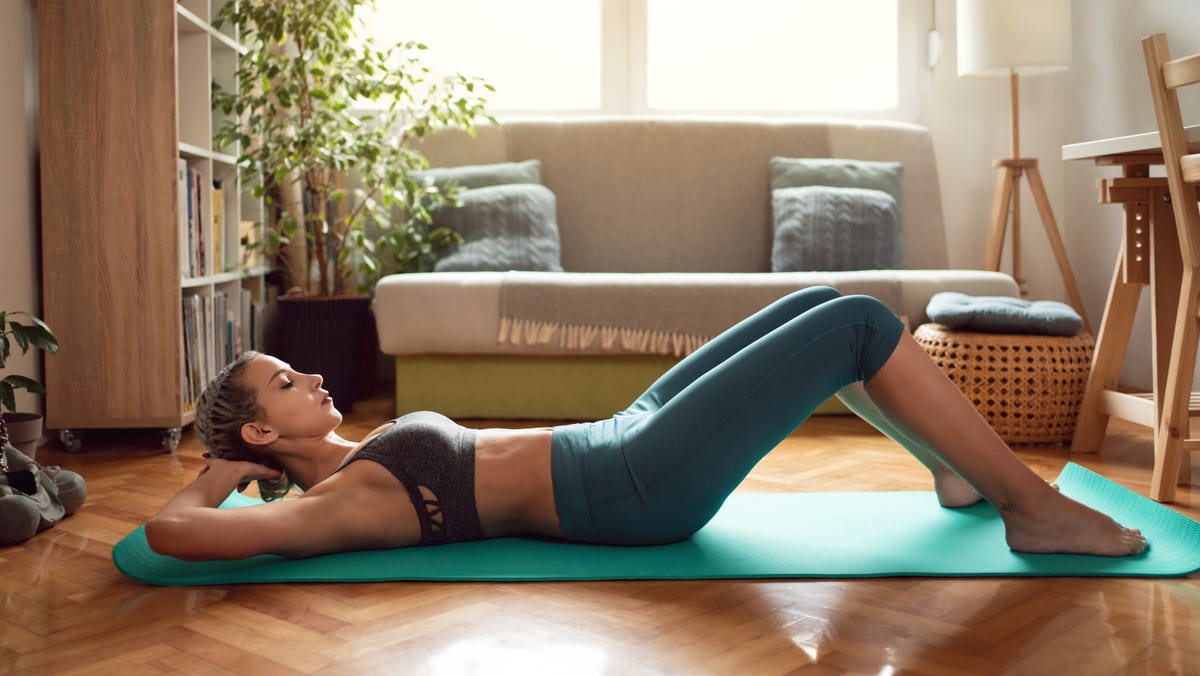
The exercise is performed laying on your back (preferably on a yoga mat or other soft surface), with your knees bent and your feet on the ground in front of you about as wide apart as your hips. Arms are either crossed to opposite shoulders over your chest or hands are placed on either side of or behind your head. Then, lift your head and shoulder blades off the ground before releasing the position and resting your head back on the ground.
“Focus on curling the spine rather than simply lifting your upper back off the ground,” advised McDonough. “And try to imagine your chest touching your belly button as this will ensure proper spinal flexion is taking place and the target abdominal muscles are being hit.”
“So long as you are creating tension in your abs, you are exercising them,” echoed Melanie Adams, an American College of Sports Medicine certified exercise physiologist and a professor of exercise science at Keene State College in New Hampshire. She explained that variable movements can also be introduced such as lifting your head and shoulders towards one side or the other or lifting your feet into the air as you slowly bicycle kick to perform an exercise known as bicycle crunches.
What are the benefits of doing crunches?
No matter which variations you follow, crunches have the advantage over sit-ups of being able to better target abdominal muscles. “Because the movement is smaller, you can control momentum more,” explained Adams. “This creates a longer contraction − demanding more endurance and more stability from your core.”
Crunches also put less strain on lower back muscles and joints. This can be helpful for anyone, but is especially beneficial “for those with previous back problems as crunches can be far less taxing than sit-ups,” explained Hess, a Salt Lake City-based personal trainer and fitness coach.
When done properly, the exercise has also been shown to strengthen the lower back − reducing risk of injury and lower back pain. Crunches can improve flexibility and posture as well. And they have the benefit of convenience “since you can perform crunches anywhere − whether it be at home or in a hotel room,” said McDonough.
What muscles do crunches work?
But the most sought-after benefit of doing crunches is muscle building. Traditional crunches, where you only lift your head and shoulder blades straight up and down, “primarily targets the rectus abdominis or upper abdominal muscles,” said Hess. The movement also strengthens the transverse abdominis − a deep muscle that stabilizes the core − and a group of muscles that runs along the spine known as the erector spinae.
Modified crunches can work additional muscle groups. “Laying on your side as you do crunches will also target your oblique muscles,” said Hess. Lifting your head and shoulders to one side or the other or engaging in bicycle crunches by involving your legs will, too. These and other variations like ones involving free weights or resistance bands can also engage hip flexor, leg and butt muscles.
How many crunches should I do a day?
When it comes to choosing how many crunches to do, it’s best to first consider your experience level. “A beginner would benefit by starting with fewer sets and reps such as three to four sets of 10 to 15 reps a day,” said Hess. “Someone with a lot more experience may work up to as many as 100 a day − but the focus should always be on quality over quantity.”
Adams agrees, noting that rather than teaching number of reps, she teaches duration. “Do the exercise slowly and controlled for 20 to 30 seconds and then build up,” she recommended. “The key is to hold your position often enough that you fatigue your muscles,” she explained. “Your ab muscles should feel shaky and like you’re unable to do another rep when you end the set.”
“As with any resistance exercise,” echoed McDonough, “challenging the target muscles to near-muscular failure with different rep ranges and techniques is ideal to optimize skeletal muscle development and strength adaptations.”
No Byline Policy
Editorial Guidelines
Corrections Policy
Source