
Land Park pharmacy becomes center of health policy debate
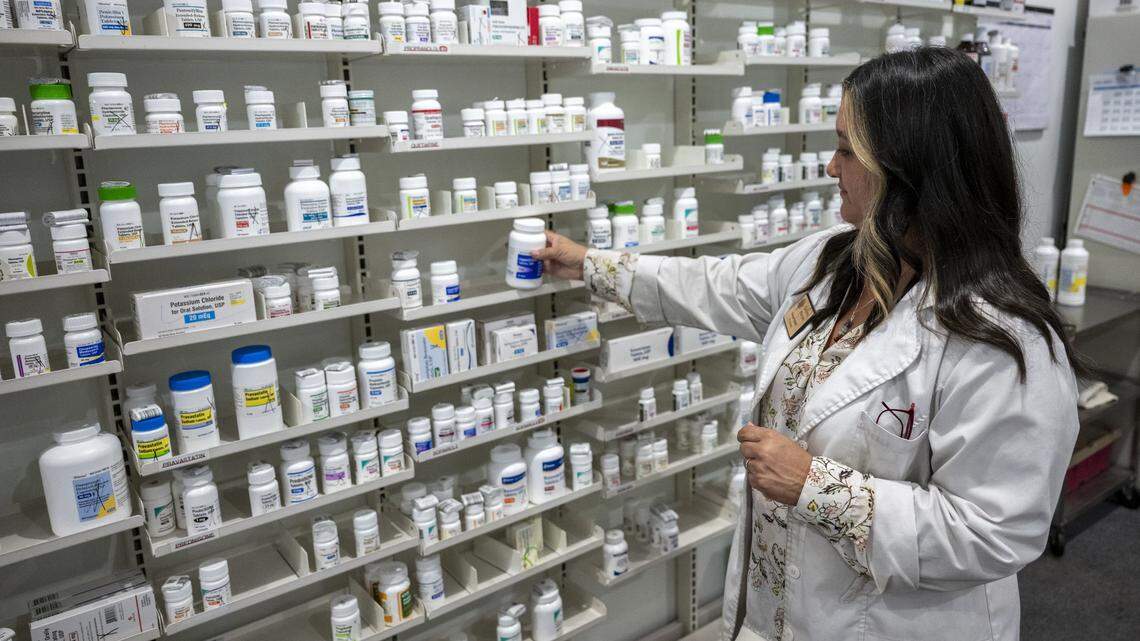
Sonya Frausto, pharmacist and owner of Ten Acres Pharmacy, grabs a bottle off the shelf inside the store in Land Park on Thursday.
dheuer@sacbee.com
Sonya Frausto thought only her patients would read the Instagram post, announcing that her independent pharmacy would close in August after five years on Freeport Boulevard.
But soon, local TV stations started calling. Frausto was asked to testify before a California Senate committee.
In her announcement, Frausto had tapped into one of the most heated topics in health care policy. While she had multiple reasons for closing Ten Acres Pharmacy, Frausto wrote, the primary one was low reimbursements from pharmacy benefits managers, or PBMs, the organizations that serve as middlemen between drugmakers, health insurers and pharmacies.
Two miles away in the Capitol, lawmakers were advancing legislation that would create new regulations for PBMs. And one of California’s largest health insurers was in the process of overhauling its PBM model.
PBMs have existed in the U.S. for about 60 years, but lawmakers have leveled more scrutiny in recent years amid industry consolidation and complaints from pharmacy groups. Critics say PBMs reimburse pharmacies too little to survive and steer patients toward their own mail-order pharmacy services.
“PBMs continue to refine their methods of extracting as much profit as possible,” said Susan Bonilla, CEO of the California Pharmacists Association. “Clearly, we’re now at a crisis point.”
The PBM industry, meanwhile, argues that prices are set by drugmakers. And there are other reasons driving pharmacy owners to close their doors, like customers’ affinity for online options and closures of other health care services in rural areas, said Greg Lopes, vice president of public affairs and communications for the Pharmaceutical Care Management Association, in an email.
“PBMs recognize that pharmacies are critical for patients to access prescription drugs,” Lopes wrote. “So it makes no sense to claim PBMs are putting independent, or any pharmacy, out of business.”
It’s a section of the health care industry that appears poised for change: Several states have passed new legislation governing PBMs. Blue Shield of California, one of the state’s largest health insurers, this year shifted away from its traditional PBM model, and launched a new structure through which it will attempt to negotiate more of its prices directly with drug manufacturers.
Other insurers and employers are watching, and some have expressed interest in doing the same, said Paul Markovich, former CEO of Blue Shield of California and current president and CEO of the insurer’s new parent company, Ascendiun.
“We want to get the right drug to the right person at the right time in the most cost-effective and convenient way possible,” Markovich said. “Pharmacy should be about quality and cost. How do you get the best quality for the most affordable price?”
Sonya Frausto, pharmacist and owner of Ten Acres Pharmacy, poses for a portrait inside the store in Land Park on Thursday. She plans to close the business in August. DANIEL HEUER dheuer@sacbee.com
Taking on losses
Frausto’s complaints about reimbursements echoed those of other independent pharmacy owners, who have described finding themselves in a counterintuitive bind wherein they can’t afford to take on more patients’ business because they’d lose too much money on the prescriptions.
“You’d think: more patients, more medications, more money. But that’s not the case at all,” said Katie Bass, who owned two California pharmacies that closed in the past year. “You try to explain it to people, and they’re like, ‘That’s not real. That can’t be real.’”
Bass closed one of her pharmacies, San Joaquin Drug in Planada, in late 2024. Her father had opened it in 2000, and Bass took it over in 2019. She closed her other pharmacy, Yosemite Drug in Coarsegold, earlier this year.
Her prescriptions in Planada were taken over by a nearby Rite Aid, which, she said, is now also expected to close.
“I feel awful,” Bass said. “It’s truly a terrible, sad situation for pharmacies. And patients, really.”
Ten Acres Pharmacy, Frausto said, recently paid almost $340 for a diabetes drug, and was reimbursed about $190, taking a $150 loss. But for a menopause drug, she netted about $50.
For other medications, Frausto was paid roughly her costs. She lost 20 cents on a $440 urinary incontinence drug, and made a little over $1 on a $5 steroid cream — a modest profit that might cover the vial the cream goes in, Frausto said, but does little for her rent, utilities or payroll for seven employees, including herself.
“At the end of the day, it is a gamble on how much money I am going to make,” Frausto said.
Clint Hopkins, CEO and pharmacist at Pucci’s Pharmacy on Folsom Boulevard, said he offsets losses on prescriptions through discount programs, and by providing pharmacy services to long-term care facilities.
Hopkins, Bass and Frausto each said that they had at times referred patients elsewhere, because their pharmacies couldn’t take on the losses for the patients’ medications.
“Sometimes we will look at an individual claim, and say, ‘Okay, we’re losing $100, we can’t do this,’” Hopkins said. “And then other times we look at it from the perspective of the total patient or the family, and we say, ‘Okay, well, we may be losing all kinds of money on the wife, but we’re making money on the husband or the kids,’ and so we’ll say, ‘Well, I guess we’ll keep taking them.’”
 Ten Acres Pharmacy on Freeport Boulevard in Land Park on Thursday, July 24, 2025. DANIEL HEUER dheuer@sacbee.com
Changes ahead?
State Sen. Scott Wiener introduced a bill that would create new restrictions for PBMs, requiring them, for instance, make additional disclosures around the rebates they receive. It would also prohibit spread pricing, the practice of charging insurers more than the PBM reimburses the pharmacy.
“This would put California out in front on PBM regulation,” Wiener said. “Right now, California is playing catch-up. But this is a very fairly comprehensive bill in terms of PBM reform, and it will make California a leader.”
Lopes, of the Pharmaceutical Care Management Association, said the bill won’t lower costs for patients or help pharmacies, and argued that drug prices are set by pharmaceutical companies. He urged the governor and legislature to require transparency “to the entire drug supply chain.” Otherwise, he wrote, “it’s virtually impossible for policymakers to know how and where the money flows.”
Wiener said he is cautiously optimistic that his PBM bill will be signed. A piece of it was passed earlier this year as part of the state budget.
“No one is suggesting that PBMs are the only issue with the cost of prescription drugs,” Wiener said. “But they are definitely one.”
Blue Shield of California submitted a letter in support of Wiener’s bill. But in the meantime, the insurer is attempting a new model for managing its 6 million members’ prescriptions.
As of January, Blue Shield of California stopped using CVS Caremark for most of its PBM services, except specialty drugs. It divided its pharmacy management responsibilities across several different companies, including Amazon Pharmacy, Mark Cuban Cost Plus Drug Company, Prime Therapeutics and Abarca.
“What we want to do is just go straight to the pharmacy manufacturers,” Markovich said. “I just went to them… and said, ‘I just want to pay for your drug.’”
Markovich said Blue Shield of California has saved between $120 million and $150 million under the initiative, and he expects that the insurer will eventually save $500 million annually. Its savings, he added, will depend on how many direct contracting deals Blue Shield can strike with drugmakers.
As part of its new structure, Blue Shield created a business through which other companies will eventually be able to access its pharmacy model.
Markovich said he believed it would have at least one announcement by the end of the year.
Related Stories from Sacramento Bee
Annika Merrilees
The Sacramento Bee
Annika Merrilees is a business reporter for The Sacramento Bee. She previously spent five years covering business and health care for the St. Louis Post-Dispatch.
No Byline Policy
Editorial Guidelines
Corrections Policy
Source