
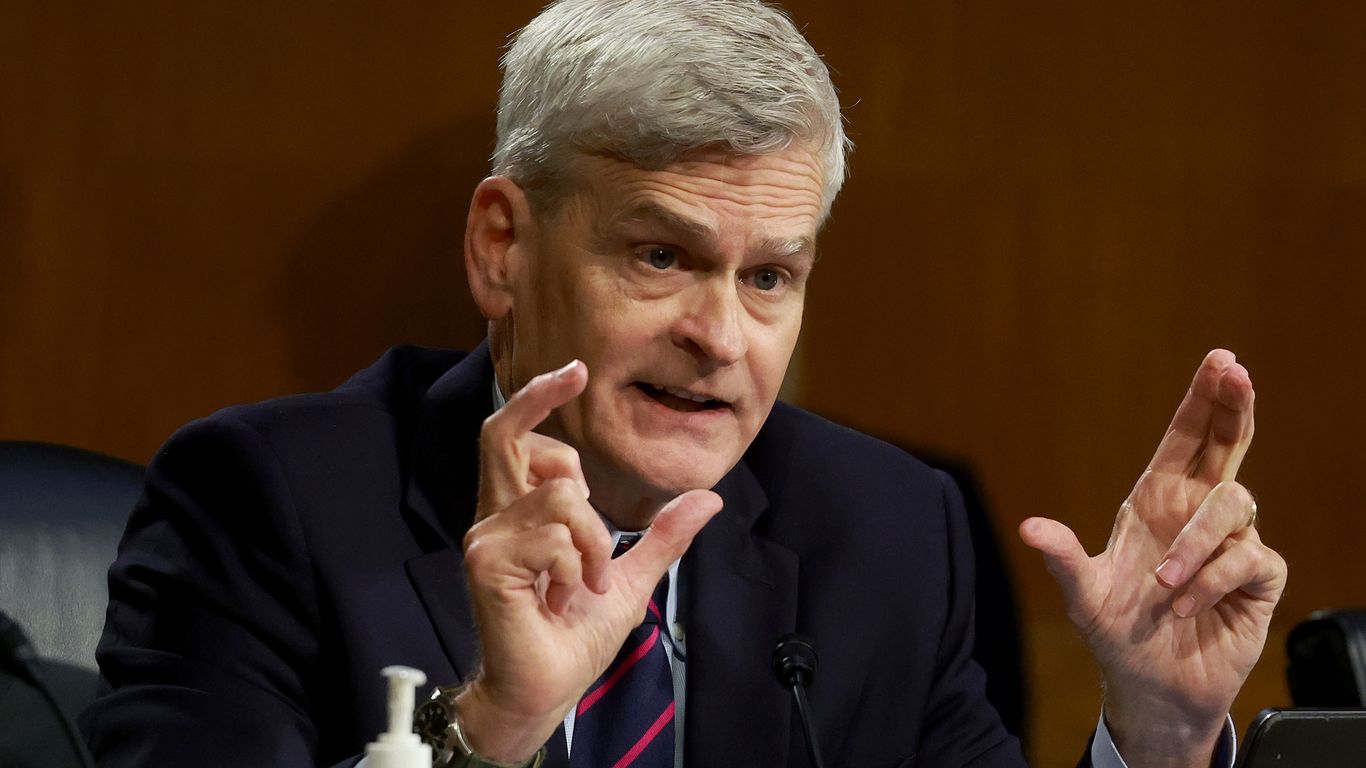
Sen. Cassidy could lead on changing how America pays for expensive gene therapies
Sen. Bill Cassidy is set to become ranking member of HELP the same year a gene therapy for sickle cell disease is expected to hit the market.
- Interestingly enough, he has written extensively about policy changes that could help the health system absorb this class of multimillion-dollar drugs.
Why it matters: Congress isn’t known for acting on anything before it becomes a crisis, and that may be the case with gene therapies — multiple therapies have already been approved.
- But Cassidy will be well positioned to at least spotlight the issue and could end up posing some unorthodox solutions, at least unorthodox coming from a Republican.
State of play: Cassidy has written on the question of how to pay for expensive new drugs in publications including JAMA and STAT. (The JAMA article is pretty unusual on its face — what other members of Congress can you think of who have written for medical journals?)
- These pieces are from a few years ago, but Cassidy’s office told Axios the issue is still on his radar.
- “Sen. Cassidy is still engaged on the development of alternative payment models. With gene therapies and other new treatments coming to market, it’s not unlikely that this issue will get more attention,” said spokesman Ty Bofferding.
The intrigue: Cassidy has been most outspoken about the “Netflix model” of paying for drugs, which Louisiana has used to pay for pricey hepatitis C drugs. The idea is generally that an insurer or government would pay a flat fee — like a subscription — for an unlimited amount of a drug.
- But his STAT op-ed also floats paying for gene therapies through a government program or a hybrid public-private fund (among other ideas). Cross your eyes and the former reads as single-payer for gene therapies.
- And on the idea of public funding, Cassidy writes this doozy of a question: “This leaves open how to establish a price. Should taxpayers be willing to pay any price without a proportionate relationship to individual and social good?”
- Cross your eyes again, and the phrase “price-setting” may appear.
The backstory: What started as a trickle of gene therapy approvals has sped up recently. It was just last month that the FDA approved a gene therapy for hemophilia, which became the most expensive drug in the world when it announced a $3.5 million price tag.
- It came on the heels of the approvals of two gene therapies by Bluebird bio, a biotech company, that cost $2.8 million and $3 million.
- Even some of the usual drug pricing critics acknowledge that gene therapies are worth a lot of money. They generally will save the health care system that money over time if they successfully cure a patient who would otherwise have required chronic care.
- The difference is that the cost of long-term treatment is, by definition, spread out over time — and that’s what our health care system is designed to accommodate.
Paying for these drugs is going to be a problem, particularly for state Medicaid programs and small businesses. The question is how quickly it trickles up onto policymakers’ radar.
- Cassidy could easily end up benefiting from being the right person in the right place.
- He not only will have authority on the issue because of his committee position, but will also be one of the few members who have thought deeply about the issue and actually know the landscape of policy solutions.
My thought bubble: Being too rigidly ideological can quickly become unworkable and impractical.
- But that hasn’t stopped Congress for years, and Cassidy could have his work cut out for him if he ends up trying to tackle the issues presented when new technologies hit an outdated payment system.
No Byline Policy
Editorial Guidelines
Corrections Policy
Source