
What Happens if an IUD Breaks?
Photo-Illustration: The Cut; Photos: Getty
One morning this past June, Sabrina Melendez drove from her home on Long Island to a Planned Parenthood clinic to get her IUD removed. She and her husband had recently decided they were ready to start a family. At 36, she finally felt stable enough in her career — she worked as an assistant branch manager at a bank — and spending time with her young niece had confirmed her desire to become a mother.
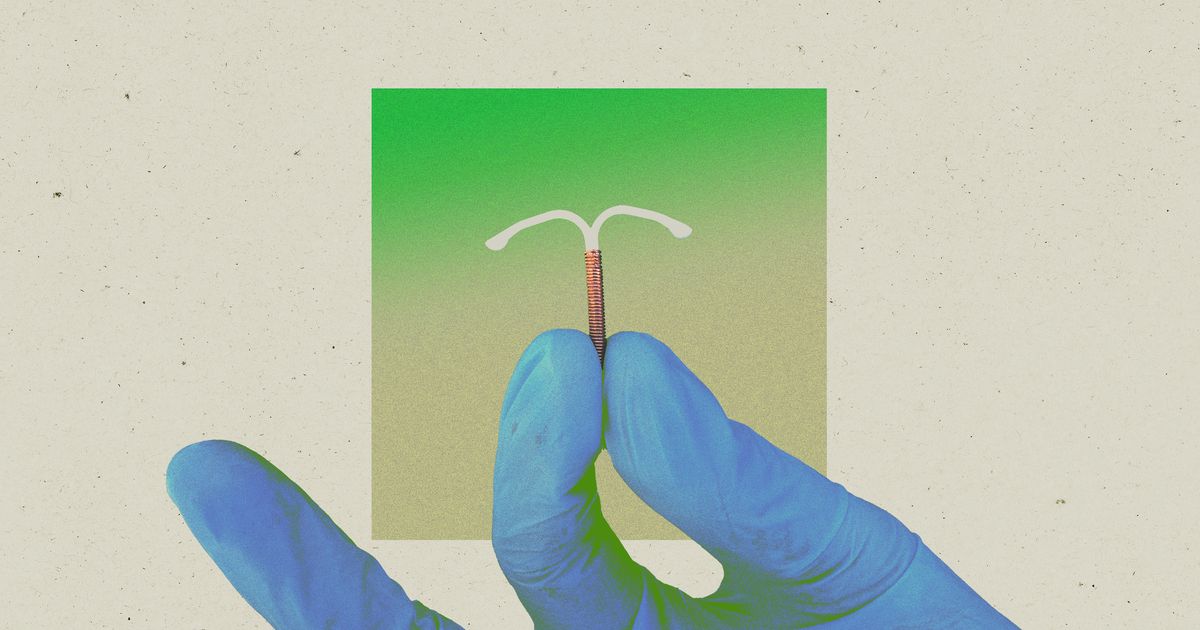
Melendez had gotten the IUD inserted in 2017. Some IUD brands work in part by releasing hormones, but because she had a condition called a prothrombin gene mutation, Melendez was told to avoid hormonal birth control. So she went with the Paragard, the only nonhormonal IUD on the market. It’s a tiny plastic T-shaped device — arms just over an inch across total, with a slightly longer vertical stem, each wrapped in copper. Once placed in the uterus, it is over 99 percent effective and can be left in for up to ten years.
Like all IUDs, the Paragard has a string attached to facilitate detection and removal. But when the doctor pulled on it, the device didn’t budge. She tried twice more — and “each pull was pretty painful,” Melendez says. Still, the thing didn’t move. The doctor told her she would need to come back for another appointment. Melendez returned two weeks later and climbed back on the exam table. This time, the gynecologist managed to extract the device, but it immediately became clear that something was wrong. The device the doctor was holding had broken. One of the arms was missing — presumably still somewhere inside Melendez’s body.
Melendez had no idea that her IUD could break upon removal. Nor do many women who rely on this form of birth control. In the FDA Adverse Event Reporting System, where patients and providers can submit complaints, there are 11,380 reports of Paragard breakage between 2009 and 2026 so far. The precise odds of this outcome are hard to pin down. A 2023 review by the FDA estimated that the frequency was 0.08 percent to 0.15 percent but noted limitations in the calculation’s methodology; a 2021 journal article put the rate at 1.25 percent, but its sample size was relatively small. In some cases, a broken IUD is a stressor and a financial burden: additional appointments, imaging, and procedures to retrieve the stranded fragment. In rarer cases, it has led to more extreme outcomes, such as chronic pain and hysterectomies.
Some Paragard users have brought lawsuits against the device manufacturers, Teva Pharmaceuticals and CooperSurgical, which acquired ownership from Teva in 2017. In 2020, these lawsuits were consolidated into what’s known as multidistrict litigation (MDL). Similar in spirit to a class-action lawsuit but technically different, an MDL funnels lawsuits from around the country into one federal court. The first trial is scheduled to begin on January 20, in the U.S. District Court in the Northern District of Georgia. The outcome of the initial case, known as a “bellwether trial,” will gauge how much value jurors see in the Paragard users’ claims. There are now a total of 3,800 plaintiffs, including Melendez. As Melendez’s attorney, Jeffrey M. Kimmel, told me, “The theory of the case is that the product is defectively designed and they’re not warning people about it.”
The Paragard’s prescribing information does warn that “Paragard can break, perforate the uterus, or be expelled.” In response to emailed questions, a Teva representative stated: “Since initial FDA approval, the label has included information about potential risks, including the possibility of device breakage and the possible need for surgical removal.” (CooperSurgical could not be reached for comment and its attorneys for the lawsuit did not respond to requests for comment.) The plaintiffs’ lawyers will argue in court that the warnings were vague and inadequate. For instance, earlier iterations of the label did not mention that breakage could be precipitated by removing the device. As a result, the attorneys contend that many providers were unprepared to deal with that situation. “Defendants intentionally downplayed the risks of breakage, including, but not limited to, during removal,” the complaint alleges.
It’s too soon to know how these arguments will play in court. But the fact that the case is going to trial means it has cleared several hurdles — “which means there are at least questions of fact that juries should hear,” said Elizabeth Chamblee Burch, a law professor at the University of Georgia who is an expert on this type of litigation.
Burch is also the author of a new book, The Pain Brokers: How Con Men, Call Centers, and Rogue Doctors Fuel America’s Lawsuit Factory, that investigates the dark side of such cases. Lawyers have financial incentives to gather as many cases as possible and play up the damages. In Burch’s telling, these motives can sometimes lead to dubious practices that benefit attorneys more their clients. “There are a lot of different problems in the system,” she said. Yet she believes such cases can fulfill a legitimate function. “There are benefits to efficiency for plaintiffs. There are strengths in numbers.”
The lawsuit raises the question of whether those who experienced IUD fracture should be compensated. It also raises questions about how the rest of us should approach the risk-benefit calculus for the Paragard. Breakage is rare, and the physicians I spoke with said that the worst outcomes could often be avoided with better training for providers. Brian Nguyen, an OB/GYN at the University of Southern California, has researched IUD fracture and considers it important to understand. But he also worries that media attention to it “may dissuade people from using a very effective method of contraception,” he told me. “Overall, the Paragard IUD I think is a very safe method. I continue to provide it for my patients. It fills an important niche as a nonhormonal contraceptive.”
The trial is taking place at a moment when legitimate concerns about the IUD are easily mixed up in a maelstrom of misinformation about birth control, and, more broadly, an erosion of reproductive rights and trust in medical authority. That’s in addition to general confusion about health, fed by a MAHA ideology that often equates “unnatural” — e.g., vaccines and artificial contraception — with harmful. The challenge is to take seriously the experiences of those who have been injured by the Paragard while also putting them into perspective. As one person who joined the lawsuit, Lillian, said to me, “I really so believe in people’s right to have contraception and reproductive care, and be able to make choices for their bodies. So I have never wanted to be part of an IUD scare wave.”
More than any other form of contraception, the IUD has gone through wild swings in its reputation over time — not unrelated, perhaps, to the fact that different models have had distinct designs and mechanisms. When the modern IUD was invented, by a German Jewish doctor named Ernst Gräfenberg in interwar Europe, he fashioned it as a small silver ring. Although he wasn’t entirely sure how it worked, he theorized that it created a harmless inflammation, which prevented fertilized eggs from implanting. Starting in the early 1960s, after two large studies with highly favorable results revived interest in the IUD, new brands came on the market in the U.S.: the Lippes Loop, which took the form of a double S; the Saf-T-Coil, a T with curly arms.
In 1971, just as fears were mounting about the side effects of the pill, the Dalkon Shield debuted and became massively popular. It soon became clear, though, that the design of this IUD was flawed. The Dalkon Shield had little “fins” or spikes intended to secure it more firmly in the uterus, which presented difficulties for insertion and removal. The biggest cause for concern was the string, which consisted of hundreds of tiny inner nylon fibers that enabled bacteria to climb from the vagina up to the uterus. (The strings of the other IUDs on the market were monofilaments, more resistant to bacteria.) Tens of thousands of women are believed to have suffered from a dangerous condition called pelvic inflammatory disease (PID) as a result of the Dalkon Shield. By 1985, more than 14,000 women had filed lawsuits, and the company filed for bankruptcy.
This scandal not only brought down the Dalkon Shield but took other IUDs with it. According to one study, 15.3 percent of American women had an IUD in 1970; by 1988, that figure had plunged to 2 percent and would continue to fall. The device’s reputation eventually recovered, thanks in part to an OB/GYN named Eve Espey. After getting a Paragard herself in 1992, she thought, Why doesn’t everyone have an IUD? She began to research the question and came to believe that the public perception of all IUDs had been unfairly tainted by the Dalkon Shield. The American College of Obstetricians and Gynecologists issues practice bulletins, influential documents that summarize the state of thinking in the field, and the most recent bulletin on the IUD had basically characterized it as a last resort. When Espey approached the organization, it offered her the opportunity to write an update. The new version, released in 2005, said: “Intrauterine devices (IUDs) offer safe, effective, long-term contraception and should be considered for all women who seek a reliable, reversible contraceptive that is effective before coitus.”
The Paragard, developed in the 1970s by the Population Council, an international nonprofit research organization behind several contraceptives, entered the U.S. market in 1988. Its copper ions impair sperm, preventing it from reaching an egg. Starting in 2000 with the Mirena, four hormonal IUDs received FDA approval, all slight variations on a theme. They release a hormone called levonorgestrel, which creates a mucus that blocks sperm, and they have a modified T shape. The Paragard form is perfectly perpendicular, with right angles; the arms of the hormonal IUDs are more flexible.
Dr. Brian Nguyen, the OB/GYN at the University of Southern California, is the guy other doctors call when their patients encounter problems with contraception. He sees patients whose IUDs are rotated, malpositioned, and broken. A few years ago, curious about whether certain brands were more susceptible to breakage, he and a co-author combed through data from the FDA’s Adverse Event database. In a paper published in February 2023, they reported their results: Between 1998 and 2022, there were 6,284 reports of breakage. Of those, 4,144 were for the copper IUD and 2,140 for hormonal IUDs — almost twice as many copper IUDs broke. The Paragard “seems to be more easily stressed and broken,” he said. He was careful to note caveats: The reporting system is voluntary, which means it’s not comprehensive, and the claims are not verified. These numbers also don’t take account of the total number of users.
Others have reached similar conclusions through different methods. Dr. Mitchell Creinin, a complex family planning specialist at UC Davis, co-conducted another study in which he and co-authors 3-D printed different IUDs, then inserted them in and removed them from a model uterus. The study, he says, suggests that stress on the joints of the arms and stem “is more likely to happen with a copper IUD, with the way that frame is, compared to the hormonal IUDs.” The arms of the hormonal IUDs appeared to be more conducive to bending up without stress on the frame. “It’s kind of a ‘no duh,’ but it’s starting to put the data there.” Creinin also points out that this device was designed decades ago, and we’ve learned more about the design since then. As the 2023 FDA review noted, “There does appear to be a lack of robust testing on the limits of the design of the product, most likely due to the fact that the product was developed over 40 years ago, when such robust testing was not a regulatory requirement.” As Creinin put it, “I mean, this is just an old design.”
After the botched IUD removal, Sabrina Melendez had to have a hysteroscopy, a procedure that in her case involved undergoing anesthesia and inserting a camera and other instruments inside the uterus. Afterward, the news from the doctor wasn’t good: They had not been able to retrieve the fragment. Regardless, Melendez was on the hook for $2,700 after insurance. When she returned for a follow-up appointment, her doctor suggested another ultrasound-guided attempt to extract the fragment. But the doctor also said that its presence shouldn’t impede her ability to have a healthy pregnancy. Wary of yet another procedure, Melendez decided to leave the fragment in her uterus and hope for the best.
Some people’s doctors have recommended more aggressive responses. In the summer of 2021, one of the plaintiffs in the lawsuit, Cherea Adams, then a 42-year-old industrial security specialist and mother of one in southern Maryland, went to get her Paragard IUD removed; a decade had passed, and she planned to have it replaced. When the nurse practitioner pulled it out, Adams recalls her saying, “Oh, shit,” and telling her it had broken. After that, she started experiencing pain and cramping.
What followed was two hysteroscopies, both of which failed to retrieve the fragment. When Adams woke up from the second, the surgeon told her that, because of the extent to which the device fragment was embedded in her uterus, the only alternative was to have a hysterectomy. “Excuse me? Really? There isn’t any other way?” Adams remembers saying. A few weeks later, her uterus was gone. “It’s pretty traumatic,” she told me. “It’s not like I was actively planning to have another child, but now I completely don’t have the option.”
One question raised by these stories is how to apportion responsibility. Is it all the fault of the manufacturer, or do health-care providers share some of the blame? Creinin believes that OB/GYNs should know by now that breakage can occur, but training varies, and some are ill-equipped to handle it if it does happen. Ideally, these doctors would refer patients to specialists like him and Nguyen, who are experienced in retrieving the fragments. But that’s not always feasible.
As a result, some providers may take extreme measures. Creinin maintains that, while hysterectomies may be warranted in a small number of cases — if the fragment is causing pain, for example — there may be other instances where they occur unnecessarily. “If it’s not causing symptoms, which is what happens a majority of the time, you don’t need to do anything. You just leave it.” Espey generally agrees. “Typically, I think there’s much more anxiety about the medical consequences than actual medical consequences,” she told me. “There is definitely something about the uterus that I think makes it a special place that people don’t think about the same way as about joint replacements or, you know, all the other things we leave in people’s bodies all the time that are potentially more of an issue actually than a tiny little plastic fragment of an IUD.”
These specialists see a need for more provider education — and many plaintiffs believe responsibility for that leads back to the manufacturer. Lillian is a clinical social worker who lives in Brooklyn, goes by they/them pronouns, and asked me to identify them by only their first name. They received conflicting advice from different doctors after a fragment of their IUD broke off and was embedded in the wall of their uterus. One wanted to “resect” — basically cut away at the uterus in search of the device — while another counseled leaving it. “It felt pretty clear that none of the providers I was working with knew what best practice was, or they disagreed about what best practice was,” Lillian said. It would have been less stressful if there had been some literature from the manufacturer, explaining what to do in this situation.
Their doctor located the missing piece during initial imaging, but once Lillian underwent a hysteroscopy, the fragment was elusive. The best-case scenario is that it was expelled at some point, even though Lillian never noticed it coming out. They worried about the implications for fertility. And there was just something creepy and unsettling about it. “Like, I was imagining being buried and all of me was decaying except for this copper arm, and that would eventually be all that was left of me,” they said.
There may be opportunities to improve current practices to make breakage less likely. For example, Creinin said his study suggested that removing it more slowly could reduce the risk of stress on the device’s joints, although he cautioned that the finding was preliminary. And, when the devices do fragment, clinicians should be trained in the most appropriate responses — not to be too hasty to resort to hysterectomy or resection, for instance.
Last year, the FDA finally approved a new nonhormonal copper IUD, the Miudella. Its shape more closely resembles that of the hormonal IUDs — more flexible — which strikes the doctors I spoke with as promising. It is expected to enter the market this year, and is approved for use up to three years.
When I last spoke with Melendez, she said she knew she was lucky compared to some of the other plaintiffs. Yet, in addition to her other health issues, this ordeal had been another setback she’d never anticipated. “I was hoping to get pregnant sooner rather than later,” she told me. She’d had to deal with multiple appointments, including a medical procedure from which her uterus needed to heal — and after all that, the residual arm was still there. But she and her husband were pressing ahead. “We’re still trying,” she said. “I’m still feeling hopeful.”
No Byline Policy
Editorial Guidelines
Corrections Policy
Source